

Probably, if they’re Christmas Tree or Pyramid Spikes and no longer than 7mm. That’s the track limit at almost every major venue in Australia. Never wear Needle or Pin Spikes.
| If you’re… | What to wear |
|---|---|
| A Little Athletics parent | Under 10 and younger: no spikes. Under 11 and older: pyramid or Christmas Tree, up to 7mm on a synthetic track, 9mm for jumps and javelin, or 12mm on grass. Your centre or venue can be stricter. |
| A school athlete heading to Perth in December | Christmas Tree or Pyramid only. No longer than 7mm for track and 9mm for jumps and javelin, including high jump. Spikes are checked in the call room. |
| All other athletes | Pyramid or Christmas Tree, 7mm on the track at almost every major venue. Jumps and javelin limits run from 9mm to 12mm depending on the venue and meet, so check its technical regulations. |
But there isn’t one rule. Spike rules come in layers: World Athletics sets the outer limits, and the track manufacturer, the venue and the meet can each tighten them. The rule published for your meet is the one the call room applies. This guide works through each layer in that order, then looks at which spike shape returns the most energy.
World Athletics
Sets the outer limits: up to 11 spikes per show, 9mm long (12mm in high jump and javelin), and a 4mm gauge test on the half nearest the tip.
Track manufacturer
May set a lower maximum or rule out shapes. Mondo and Rekortan recommend a quarter-inch (6.4mm) for running, Conica any World Athletics length, and none allow Needle spikes.
Venue operator
Sets the house rule, often for training as well as competition. Most Australian venues: 7mm on the track, 9mm for jumps, no Needles.
Meet technical regulations Read this one
The meet’s own rules, including Little Athletics age rules. They can be stricter than the venue.
Call Room
Checks your spikes against the meet’s published rule. Always check your spikes before you reach the stress of the Call Room.
World Athletics rules
World Athletics sets only the outer limits: up to 11 spikes, a 9mm maximum (12mm in high jump and javelin), and one width test. Anything stricter is handed to the track manufacturer and the venue. The rules sit in Technical Rule 5 and the Athletic Shoe Regulations (Book of Rules).
| Rule | What it says |
|---|---|
| Number of spikes | Up to 11 spikes per shoe, and no more than 11 spike positions |
| Length | The part that projects from the sole or heel must not exceed 9mm. High jump and javelin: 12mm |
| Width test | For at least the half of its length nearest the tip, the spike must fit through a square-sided 4mm gauge |
| Stricter limits | If the track manufacturer or stadium operator sets a lower maximum, or bans certain shapes, that applies |
| Surface | The surface must be suitable for the spikes permitted |
| Cross country | Meet regulations or Technical Delegates may allow longer spikes, depending on the surface |
| Sole thickness | Since 1 November 2024: 20mm for track and field spike shoes and cross-country spikes; 40mm for road |
- The rulebook names no shapes. Pyramid, Christmas Tree and Needle don’t appear in it. Shape rules exist only because it hands them to manufacturers and venues.
- 9mm is the ceiling, not the default. World Athletics’ facilities rule (2026 edition) says a synthetic track should preferably accept 6mm spikes, and that the manufacturer or operator may allow up to 9mm.
- Cross country runs longer. For the 2026 Australian Cross Country Championships in Ballarat, Australian Athletics recommended 9mm as the baseline and 12–15mm if the course was very wet (relays regulations).
- Pro running sets its own rules. The Victorian Athletic League has no rule on spike length, and 18mm spikes are common among sprinters on its grass tracks.
- Shoes are checked at the top end. National championships and World Athletics-ranked meets also check that the shoe itself is approved, using World Athletics’ online shoe checker.
The four main styles of spikes

Track manufacturer specifications
Track manufacturers can set a lower maximum than World Athletics or rule out shapes, and they don’t all agree. Mondo, Rekortan and CONICA each accept Pyramid and Christmas Tree spikes and rule out Needles, but they disagree on which shape is better and why.
| Surface | Running length | Jumps and throws | Allowed | Not allowed |
|---|---|---|---|---|
| Mondo (Super X, Mondotrack; Bulletin 11-001, 2015) | 6.4mm (1/4″) | No separate figure | Pyramid, compression tier (Christmas Tree) | Needle “should be avoided” |
| Rekortan (care manual, Rev 7, 2024) | 6mm (1/4″) | 9mm (3/8″) | Pyramid (preferred), Christmas Tree | Needle, pin: never permitted |
| CONICA (written guidance) | 9mm outdoors; 6mm indoors | 12mm for high jump and javelin, where permitted | Pyramid, Christmas Tree | Needle |
Mondo sets out its position in Bulletin 11-001, last revised in June 2015. It sorts spikes into three types. Pyramids, it says, “penetrate the track material upon contact”. Compression tier spikes (Christmas Trees) are “still somewhat conical”, but with tiered construction and a flat tip, and are designed to compress the surface and use its resilience to return energy. Needles should be avoided. The bulletin says a surface must be at least 10mm thick to take spikes, and that spike length and shape should be controlled as part of good facility management. When we asked whether it was still current, Mondo pointed us to an editorial article on its website.
Rekortan sees it the other way round. Its care manual (Rev 7, May 2024, issued by Advanced Polymer Technology) says Rekortan “highly recommends and prefers” pyramid spikes. It says their flatter profile gives a lower point load, so they compress the surface rather than dig in, returning energy especially in sprints. Christmas Trees are allowed. Needles and pins are never permitted, and using them affects the warranty. The manual also asks venues to supervise start areas and restrict training in lanes 1 and 2, which wear fastest.
CONICA gave us its guidance in writing. Its systems are designed and tested to World Athletics requirements, so the World Athletics limits apply unless a venue sets stricter ones. It prefers pyramid or Christmas Tree spikes for surface protection, says ceramic spikes can help, and suggests Pyramids of around 6mm for running outdoors.
Why 6.4mm, 6mm and 7mm are effectively the same limit. Spikes were sized in inches long before packaging went metric, and the standard track spike was a quarter-inch. When the labels changed, the spike didn’t: a quarter-inch spike is advertised as 6mm, but it’s actually 6.4mm. Mondo writes its limit as 6.4mm and Rekortan as 6mm, but both mean a quarter-inch. Or 7mm if rounding up.
Know which surface you’re on. The WA Athletics Stadium in Perth is Mondo. QSAC in Brisbane is Rekortan. Sydney Olympic Park has Polytan’s Rekortan Gel G13 (AIS). A manufacturer’s guidance only applies to its own surface.
Venue rules
Venues set their own house rules, and nearly every major Australian track lands in the same place: 7mm on the track, 9mm for jumps, Pyramid or Christmas Tree, no Needles or Pins. Three examples show where they differ.
| Venue | Surface | Track | Jumps | Javelin, high jump | Shapes | Also note |
|---|---|---|---|---|---|---|
| WA Athletics Stadium, Perth | Mondo | 7mm | 9mm | 12mm | Christmas Tree, Pyramid | Ceramic or metal “irrelevant”, not monitored |
| Sydney Olympic Park Athletic Centre | Rekortan (Polytan) | 7mm | 9mm | 9mm (all throws and jumps) | Pyramid, Christmas Tree | Blocks compulsory in spikes for laned events to 400m |
| QSAC, Brisbane | Rekortan | 7mm | 9mm | 12mm | Christmas Tree, Pyramid | Ceramic or metal not monitored. |
- Javelin and high jump differ. Perth and Brisbane allow 12mm as a track rule. Sydney holds all throws and jumps to 9mm.
If your meet hasn’t published technical regulations yet, the venue’s rule is the next best guide.
Meet technical specifications
The meet’s own technical regulations are the last word, and they can be stricter than the venue. Australian Athletics publishes them for its championships and invitational meets; Little Athletics and school carnivals put them in the carnival information. Read the spikes section before you pack.
Christmas Tree variations are named differently. No manufacturer or venue publishes a measurable definition of a Christmas Tree spike, and meets describe the variations in different ways.
How spikes are checked. Call room officials check that shoes, spike numbers and dimensions comply (see Call Room Protocols). Length is checked with a spike gauge, not calipers: a quick pass-or-fail test of the part that projects from the sole. Shape is checked by eye against the meet’s permitted types. Often that’s against a simplified diagram, rather than technical drawings or photos of real spike designs.
Little Athletics and school carnivals
Little Athletics bans spikes for Under 10s and younger, phases them in from Under 11, and caps them at 7mm on a synthetic track, 9mm for jumps and javelin, and 12mm on grass. These are the national Standard Rules for Competition 2026–27, published by Australian Athletics.
| Age group | Track events | Jumps and javelin |
|---|---|---|
| Under 10 and younger | No spike shoes | No spike shoes |
| Under 11 and Under 12 | Only events run entirely in lanes: sprints to 400m, hurdles, 4x100m relay | Long jump, triple jump, high jump, javelin |
| Under 13 and older | All track events except walks | Long jump, triple jump, high jump, javelin |
| Surface | Track | Long jump, triple jump, high jump, javelin |
|---|---|---|
| Synthetic | 7mm | 9mm |
| Grass | 12mm | 12mm |
- Fill every hole. Every spike well needs a spike or a blank, with no more than two blanks per shoe.
- Cover them off the field. Spikes can’t be worn outside the field of play unless they’re covered.
- The venue still decides. The limits are “subject to any further constraint from ground policies”.
The national rules don’t name a shape, so that comes from the venue. Little Athletics Victoria says most venues, including Lakeside Stadium, ban needle and pin spikes (LAVic booklet). Little Athletics Queensland carnival programs allow only Christmas Tree and pyramid on synthetic surfaces (LAQ program).
School carnivals follow similar rules. Queensland School Sport allows 7mm on a synthetic track, 9mm on a synthetic field and 12mm on grass, pyramid or Christmas Tree only (QSS). Some primary meets go stricter: Sydney Catholic primary athletes can’t wear spikes in the 800m or 1500m (Sydney Catholic Schools).
Buying first spikes, or racing on grass? See Does my child need spikes?
What’s best: a guide to energy return
On a Mondo track, the only published test favours the Christmas Tree. On any other surface nobody has tested it, and the track makers disagree about why either shape works: Mondo says the Christmas Tree compresses the track, and Rekortan says the Pyramid does.
What the evidence says

The idea has been tested once in published work. In 2014, Bahamonde and colleagues drove five 7mm spikes into a Mondo sample with a materials-testing machine: Needle, Pyramid, Post, Christmas Tree and Modified Christmas Tree (ISBS 2014).
- Every spike went into the surface, at loads under 105N, about the weight of a 10.7kg mass on one spike. Running puts far more through the forefoot: peak vertical force is roughly 1.2 to 2.5 times body weight, or about 950–1,950N for an 80kg athlete, shared among the spikes in contact. The authors called the idea that compression spikes penetrate less “unfounded”.
- The Modified Christmas Tree returned the most energy, by a significant margin over the other four. The authors put this down to its larger contact area.
- The Pyramid came second, returning significantly more than the needle and the post.
- The Needle returned the least.

The authors are clear about the limits. The study was preliminary, tested one spike at a time on one surface, and measured small amounts of energy. They said it’s hard to know how much it helps a sprinter. Nobody has repeated it on Rekortan or any other surface, or with modern carbon-plated spikes.
Mondo points athletes to the same study. An editorial article on its site concludes that on Mondo’s vulcanised rubber, the best spike has the largest contact surface without particular penetration, such as a Christmas Tree, though comfort still matters.
So it isn’t compress versus pierce. Every spike goes into the track. What changes is how much of the surface it loads, and how much energy comes back.
| Pyramid | Christmas Tree | |
|---|---|---|
| Shape | Smooth cone narrowing to a point | Stacked tiers, flat tip, “somewhat conical” |
| Mondo says | Penetrates the track | Designed to compress it |
| Rekortan says | Compresses it; preferred | Allowed |
| Energy return on Mondo (2014 study) | Second of five | Modified version first of five |
| Allowed by | Every venue and track maker in this guide | Every venue and track maker in this guide |
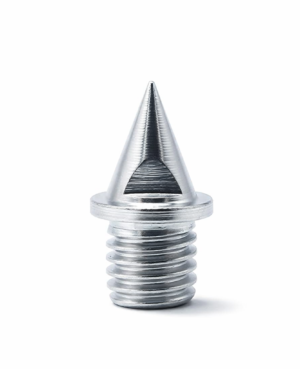
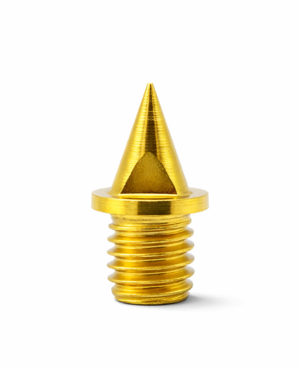
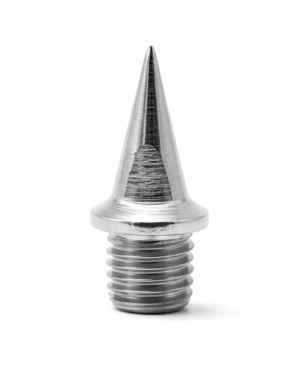
Pyramid spikes
The pyramid is the safe choice. It’s allowed by every track maker and venue in this guide, nobody argues about what one is, and Rekortan names it as its preferred spike. It came second in the only energy test, and it’s the spike most new shoes come with. Pick pyramids for training, for grass and cross country, and whenever you’re not sure what the next track allows.
- From $26.99 ⚡Arrives by Wednesday 18 NovemberSelect options This product has multiple variants. The options may be chosen on the product page
- From $13.99 ⚡Arrives by Wednesday 18 NovemberSelect options This product has multiple variants. The options may be chosen on the product page
- From $13.99 ⚡Arrives by Wednesday 18 NovemberSelect options This product has multiple variants. The options may be chosen on the product page
 From $15.99 ⚡Arrives by Wednesday 18 NovemberSelect options This product has multiple variants. The options may be chosen on the product page
- From $15.99 ⚡Arrives by Wednesday 18 NovemberSelect options This product has multiple variants. The options may be chosen on the product page
- From $15.99 ⚡Arrives by Wednesday 18 NovemberSelect options This product has multiple variants. The options may be chosen on the product page
- From $15.99 ⚡Arrives by Wednesday 18 NovemberSelect options This product has multiple variants. The options may be chosen on the product page
- From $15.99 ⚡Arrives by Wednesday 18 NovemberSelect options This product has multiple variants. The options may be chosen on the product page
- From $15.99 ⚡Arrives by Wednesday 18 NovemberSelect options This product has multiple variants. The options may be chosen on the product page
- From $15.99 ⚡Arrives by Wednesday 18 NovemberSelect options This product has multiple variants. The options may be chosen on the product page
- From $15.99 ⚡Arrives by Wednesday 18 NovemberSelect options This product has multiple variants. The options may be chosen on the product page
- From Original price was: $29.98.$25.45Current price is: $25.45. ⚡Arrives by Wednesday 18 NovemberSelect options This product has multiple variants. The options may be chosen on the product page
- From $13.99 ⚡Arrives by Wednesday 18 NovemberSelect options This product has multiple variants. The options may be chosen on the product page
- From $15.99 ⚡Arrives by Wednesday 18 NovemberSelect options This product has multiple variants. The options may be chosen on the product page





Christmas Tree spikes

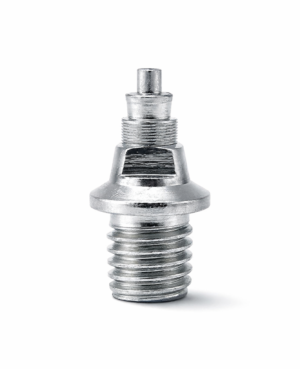
The Christmas Tree is the performance choice on Mondo. It’s the shape Mondo’s compression tier category is built around, a modified version led the only energy test, and Mondo’s own editorial article points to it. The catch is definition (or the lack of one): some officials treat the variations differently. To be safe, carry an alternative Christmas Tree design or backup Pyramid spikes.
- From $13.99 ⚡Arrives by Wednesday 18 NovemberSelect options This product has multiple variants. The options may be chosen on the product page
- From $15.99 ⚡Arrives by Wednesday 18 NovemberSelect options This product has multiple variants. The options may be chosen on the product page
- From Original price was: $29.98.$25.45Current price is: $25.45. ⚡Arrives by Wednesday 18 NovemberSelect options This product has multiple variants. The options may be chosen on the product page


Our pick, by situation
- Racing on Mondo (e.g. WA Athletics Stadium): a Christmas Tree, within the track and meet’s limits, or 6mm Pyramid.
- Racing on Rekortan (QSAC, Sydney Olympic Park): a 6mm Pyramid, Rekortan’s preferred shape and length. Christmas Trees are also allowed, and nobody has tested energy return on Rekortan, so grip and feel can decide.
- Training at more than one track: 6mm Pyramid. A combo pack – steel and lite versions – covers durability and wear.
- Grass track and field: Pyramid, 9–12mm. Little Athletics allows up to 12mm on grass.
- Cross country: Pyramid, 9mm as a baseline, 12–15mm in very wet conditions.
- Pro running on grass: 15mm or 18mm for sprinters. Distance runners can follow the cross country advice.
- Never on a synthetic track: Needles. They returned the least energy, all track manufacturers in Australia prohibit them, and we don’t stock them.
Material is a matter of preference. Perth and Brisbane venues say ceramic or metal doesn’t matter and isn’t monitored. Mondo’s 2014 bulletin recommended ceramic, but its 2015 revision dropped that, and CONICA says ceramic can help protect the surface. No study links material to energy return, so choose on weight, wear and price. Carbonlite and titanium spikes are lighter than steel, and titanium doesn’t rust.
Before you compete: a checklist
- Find the meet’s own rules. Read the spikes section of the technical regulations or carnival information. It overrides anything you remember from another track.
- No meet rules yet? Read the venue’s. Most stadiums publish them on their booking or training pages.
- Check the length against the meet’s limit. A spike advertised as 6mm is a quarter-inch, within the track limit at every venue in this guide.
- Check the shape. Pyramid or Christmas Tree. No Needles or Pins.
- Check jumps and javelin separately. Limits run from 9mm to 12mm depending on the meet, even at the same stadium.
- Fill every hole. Use a spike or a blank in every well. Little Athletics allows no more than two blanks.
- Pack spares and a spike key in your competition bag, not at home or the accommodation.
- Take them off or cover them once you leave the competition area.
Sources
Rules and regulations
- World Athletics, Book of Rules (Technical Rules C2.1, Athletic Shoe Regulations C2.1A)
- World Athletics, Technical Rule 5 as amended July 2020
- Coach Athletics, Permitted sole thickness from 1 November 2024
- Australian Athletics, Call Room Protocols
- Australian Athletics, Little Athletics Standard Rules for Competition 2026–27
- Little Athletics Victoria, Centre Uniform Booklet (Sept 2024)
- Little Athletics Queensland, South East regional program
- Queensland School Sport, Track and field
- Sydney Catholic Schools, Athletics
Meet technical regulations (Australian Athletics)
- 2026 Australian All Schools Championships (30 September 2026)
- 2026 Australian Cross Country Relays
Track manufacturers
- Mondo, Bulletin #11-001, Spike Recommendations for Super X and Mondotrack, revised 10 June 2015 (supplied copy); earlier May 2014 revision
- Mondo, Athletic spikes: how much do you know about them?, by coach Alessandro Bacci
- Rekortan, Guidelines for the Care and Maintenance of Your Rekortan Synthetic Track, Rev 7 (17 May 2024), issued by Advanced Polymer Technology (supplied copy)
- CONICA, written spike guidance supplied to spikes.au, November 2026 (cited with permission)
Venues
- VenuesWest, WA Athletics Stadium FAQ
- Athletics West, WA Athletics Stadium training guidelines (Jan 2023)
- Sydney Olympic Park, General training
- QSAC, Public training information
Research
- Bahamonde R, Streepey J, Goyke L, Myers A, Mikesky A. Energy return of different shapes of track spikes. ISBS Conference Proceedings, 2014, 32(1): 249–252.